
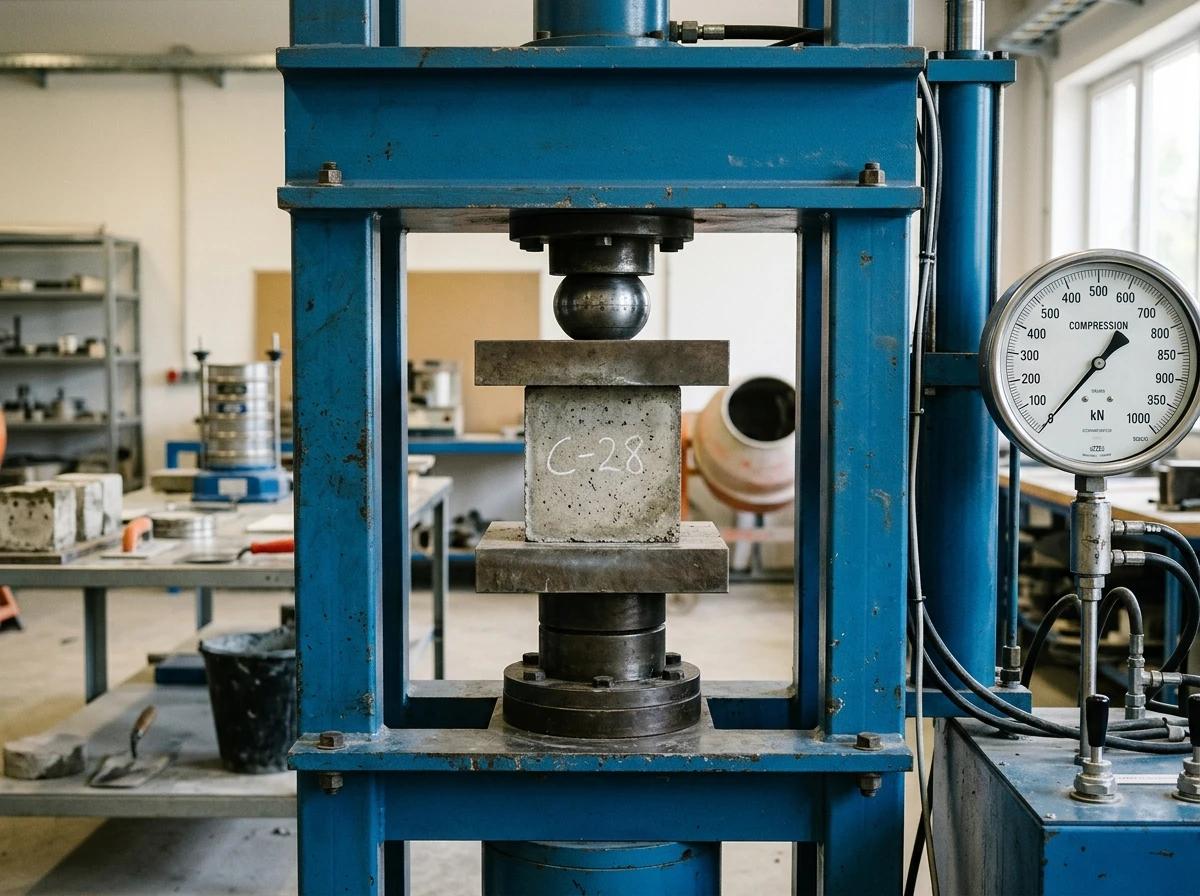
Key Takeaways & Engineering Summary
- Concrete cube testing evaluates whether the compressive strength of freshly poured concrete meets design specifications.
- Specimens are commonly prepared in 150mm standard steel or cast-iron moulds under standardized compaction methods.
- Testing intervals typically occur at 7 days (early-age indicator) and 28 days (characteristic design strength).
- Proper sampling, water curing, and testing alignment are crucial to avoid false strength deficiencies.
1. The Role of Compressive Strength in Structural Integrity
In modern reinforced concrete construction, compressive strength is the primary benchmark used by structural consultants and civil engineers to verify that a structure can safely carry its intended loads. Because concrete is designed primarily to resist compression while reinforcement steel handles tension, any deficiency in compressive capacity directly undermines structural stability.
Concrete cube testing provides an empirical, verifiable record of the concrete batched and placed on site. It ensures that the water-cement ratio, aggregate grading, batching accuracy, and admixture dosages used during actual placement delivered the anticipated engineering performance.
2. Standard Sampling and Curing Procedures
Reliable test results depend on disciplined sample collection directly at the point of discharge or placement. Samples are cast in rigid 150mm moulds in layers, with each layer compacted either mechanically or using a standard tamping bar to eliminate honeycombing and entrapped air.
After initial set (typically 24 hours under damp burlap at site), cubes are demoulded and immediately submerged in clean water curing tanks maintained at specified temperatures until the designated test age. Common test ages include 7 days (to confirm early strength development, typically reaching 65% to 70% of target) and 28 days (to confirm 100% characteristic compressive strength).
3. Common Factors Affecting Test Results
Variations in test outcomes often stem from sampling discrepancies rather than concrete batch failure. Inadequate compaction in the mould creates voids that act as stress concentrators during loading, leading to premature shear failure.
Similarly, irregular specimen faces, temperature fluctuations during site curing, or delays in transferring cubes from site to testing facilities can introduce variance. Ensuring rigorous adherence to standardized sampling procedures is essential for accurate project records.
4. Coordinating Testing for Projects in Hyderabad
For residential high-rises, commercial developments, and infrastructure projects across Hyderabad, maintaining regular cube testing schedules is standard quality assurance practice. When test results suggest variance, supplementary non-destructive testing (such as rebound hammer or ultrasonic pulse velocity) is often employed to evaluate in-situ performance without structural damage.
Technical Questions & Direct Answers
What is the standard size for concrete test cubes?
The standard size used in Indian construction practice is 150mm x 150mm x 150mm for nominal aggregate sizes up to 38mm. In cases where maximum aggregate size does not exceed 20mm, 100mm cubes are sometimes referenced.
Why is concrete tested at 7 days as well as 28 days?
Testing at 7 days provides an early indicator of strength gain, typically reaching 65% to 75% of the 28-day target. This allows project teams to spot potential batching errors early, before higher floors are cast or formwork is stripped.
How can SVR BuildTech support your project's testing requirements?
SVR BuildTech coordinates material testing requirements, sample logistics guidance, and technical evaluation for builders and contractors across Hyderabad and Telangana.
Need Technical Assistance for Your Construction Site in Hyderabad?
SVR BuildTech coordinates material testing requirements, admixture selection, and site technical consultancy across Hyderabad and Telangana.